
Why Are Your North Miami Roof Tiles Cracking? Common Myths Debunked
Tile roofs cover the majority of residential homes across North Miami and the broader South Florida corridor, yet cracked and broken tiles remain one of the most misunderstood roofing problems homeowners face. The assumption is usually simple: a tile cracked because something hit it. The reality is almost always more complicated, and acting on the wrong assumption can leave the underlying cause untouched while the damage quietly spreads. Understanding what actually causes tile failure in North Miami's specific environment is the first step toward protecting your home.
This guide walks through the most persistent myths about cracking roof tiles in the Miami area, replaces them with grounded explanations, and shows you when a professional inspection is the right call. If you are already seeing damage and want to understand your repair options, the full tile roof repair guide for South Florida homeowners covers the repair process in detail.
Myth: Roof Tiles Only Crack When Something Hits Them
Reality: Impact is one cause, but it is far from the most common one in North Miami.
Yes, a falling branch, a hailstone, or a misplaced foot during an inspection can crack a tile. But in South Florida, the majority of cracked tiles that roofers find during inspections were never struck by anything at all. The more frequent culprits are thermal movement, moisture cycling, and structural stress, all of which operate invisibly over years.
North Miami sits in USDA Hardiness Zone 10b and experiences intense ultraviolet radiation year-round. Clay and concrete tiles expand when they heat up under the afternoon sun and contract as temperatures drop overnight or during a fast-moving cold front in January. Over hundreds of cycles, that repeated expansion and contraction creates micro-fractures, particularly at the edges and nail holes where the tile is constrained. By the time a crack is visible from the ground, the fracture process has usually been underway for months.
This matters practically: if you only replace the visibly broken tile without investigating the surrounding tiles and the underlayment beneath them, you may be addressing a symptom rather than the pattern of stress that caused it.
Myth: Concrete Tiles Are Basically Indestructible
Reality: Concrete tiles are durable, but they are porous and absorb moisture, which makes them vulnerable in South Florida's humidity.
Concrete tile roofing is popular across Miami-Dade County partly because of its weight and wind resistance, and it does perform well in many respects. But concrete is a porous material. In North Miami's climate, where humidity regularly climbs above 80 percent and afternoon rain showers are a near-daily occurrence from June through October, moisture absorption is a real concern.
When water penetrates the surface of a concrete tile and then heats up rapidly under the Florida sun, it expands as vapor. That internal pressure can cause surface spalling or deepen existing micro-cracks. The same process accelerates if a tile's factory-applied coating or paint layer has worn away, which is common on roofs that are more than ten to fifteen years old and have not been cleaned or recoated.
Homeowners sometimes assume that because their concrete tile roof looks solid from the street, no maintenance is needed. A professional inspection often tells a different story. Tiles that appear intact from below may have spider-web cracking on their upper surface that only becomes visible up close, and that surface damage is the entry point for the next season's moisture cycle.
Myth: Clay Tiles Don't Need Maintenance in a Warm Climate
Reality: The warm, wet Miami climate is actually harder on clay tiles than a dry climate would be.
Clay tiles are fired at high temperatures and are inherently resistant to rot, insects, and many forms of chemical degradation. That durability leads to a common assumption: clay tiles take care of themselves. In a dry desert climate, that is closer to true. In North Miami, it is not.
The combination of persistent moisture, organic debris accumulation, and biological growth changes the equation significantly. Algae, lichen, and moss establish themselves readily on clay tile surfaces in South Florida. Beyond the aesthetic issue, these organisms retain moisture against the tile surface and can work their way into small existing cracks, accelerating the fracture process through root penetration and freeze-thaw-like moisture cycling during temperature swings.
Clay tile repair in Miami also involves matching the profile and color of the original tile, which can be tricky on older roofs. Many North Miami neighborhoods developed rapidly during specific building booms, and tiles from those eras may no longer be in standard production. This is worth knowing before assuming a clay tile repair is straightforward, and it is one reason an experienced local roofer's familiarity with regional tile profiles matters.
If you want it handled correctly the first time, consider professional roof repair in North Miami.
For guidance on keeping biological growth from accelerating tile damage, the article on safe roof tile cleaning in Miami covers the right approach without risking tile breakage during the process.
Myth: A Few Cracked Tiles Are a Cosmetic Problem, Not a Structural One
Reality: Cracked tiles are the surface signal of a system that is no longer waterproof at that point.
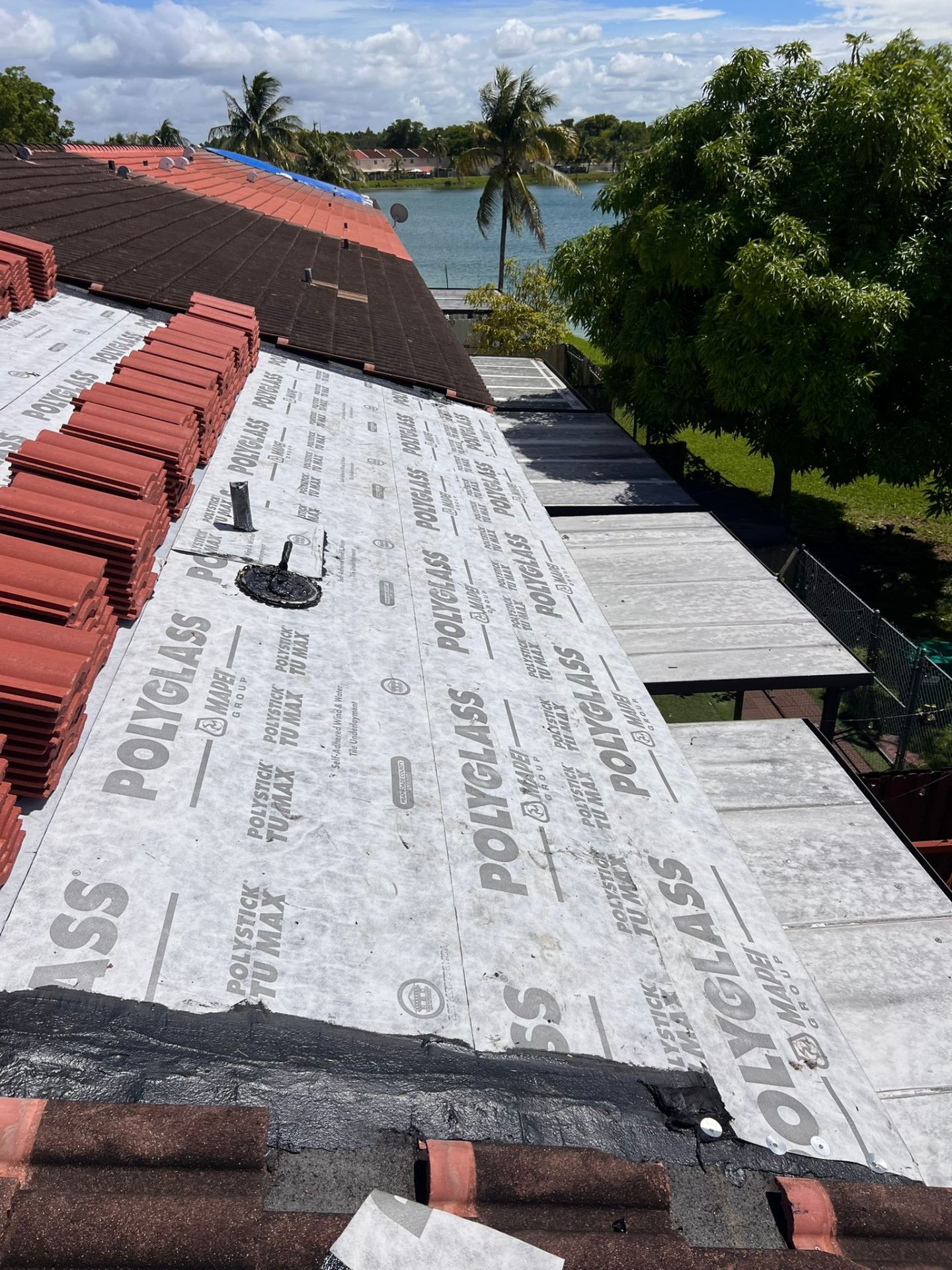
Tile roofing is a two-layer system. The tiles themselves are the first line of defense, shedding the bulk of rainfall and providing UV protection. But they are not the waterproofing layer. That function belongs to the underlayment beneath the tiles, typically a felt or synthetic membrane installed over the roof deck. The tiles protect the underlayment from degrading too quickly.
When a tile cracks, water no longer sheds cleanly at that point. Instead, it channels through the crack and sits against the underlayment. In North Miami's high-rainfall season, that concentrated moisture exposure accelerates underlayment degradation dramatically. Most underlayment products installed in South Florida have a rated service life that assumes the tile above them is intact. A cracked tile can reduce the effective lifespan of the underlayment beneath it by years.
By the time a homeowner notices a water stain on a ceiling or a drip during a storm, the underlayment at that location has often already failed. The repair at that stage involves not just the tile but potentially the underlayment and, in worse cases, the roof deck beneath it. Addressing cracked tiles early is almost always less involved than addressing a leaking tile roof after water has entered the structure. If you are already seeing interior signs of moisture, the guide on recognizing a leaking tile roof in North Miami can help you assess what you are dealing with.
Myth: Walking on a Tile Roof to Inspect It Is Fine If You Step Carefully
Reality: Tile roofs in South Florida require specific foot placement techniques, and untrained walking is a leading cause of new tile breakage.
This myth is particularly common after a storm, when homeowners want to get up and check for damage themselves. The impulse is understandable, but tile roofs are not designed to bear point loads in the middle of the tile. The correct walking path follows the batten lines or the overlap zones at the tile edges, where the tile rests on a solid surface below. Walking in the field of the tile, where it spans unsupported, is how tiles crack under a person's weight.
In North Miami, where many tile roofs are aging and may already have micro-fractures from years of thermal cycling, even a careful homeowner can cause multiple new breaks in a single inspection walk. Professional roofers know the correct path across a tile roof and carry the right footwear and equipment to minimize additional damage during assessment.
If you want to check your roof after a storm, a visual inspection from the ground with binoculars or from a ladder at the eave (without stepping onto the roof surface) is a safer approach. For a thorough assessment of the full roof system, a professional inspection is the appropriate tool, and it also produces documentation useful for insurance purposes after a named storm.
Myth: Tile Cracking Is Covered by Homeowners Insurance Without Any Caveats
Reality: Coverage depends heavily on the cause of the damage, and Miami-Dade's insurance landscape has its own complexities.
Florida homeowners insurance policies vary significantly in how they treat roof damage, and Miami-Dade County has seen substantial changes in the insurance market over the past several years. Many policies distinguish between sudden accidental damage (a tree limb falls and breaks tiles during a named storm) and gradual deterioration (tiles that have been cracking slowly due to age and thermal stress).
Gradual deterioration is typically excluded from standard coverage. This means that a homeowner who defers maintenance and allows cracked tiles to accumulate over several seasons may find that the resulting leak is classified as a maintenance failure rather than a covered event. Insurance adjusters in South Florida are experienced at distinguishing storm damage from pre-existing deterioration, and documentation of regular maintenance and timely repairs can matter when a claim is filed.
Many North Miami homeowners rely on expert roof repair in North Miami for exactly this.
Requirements and policy terms vary, so reviewing your specific policy and consulting a licensed public adjuster or your insurer directly is the right approach rather than relying on general assumptions about what is covered. What a roofing contractor can help with is documenting the condition of your roof before and after a storm event, which supports the claims process regardless of which direction it goes.
Myth: Any Roofer Can Match and Replace a Broken Tile on a Miami Roof
Reality: Tile matching in North Miami requires familiarity with regional profiles, and a poor match creates new problems.
North Miami's residential neighborhoods include homes built across several decades, with tile profiles ranging from Spanish S-tile and flat concrete tiles to low-profile barrel clay tiles. The tile profile, color, and surface texture all affect how water sheds across the roof. Installing a replacement tile with a slightly different profile can create a gap or an uneven overlap that channels water where it should not go.
Color matching is a secondary but real concern. A tile that is visually mismatched is not just an aesthetic issue; it can also signal to an insurance adjuster that prior repairs were made, which may affect how a future claim is evaluated. Roofers with consistent experience in the South Florida market are more likely to have access to regional tile suppliers and to know which profiles are still available for common North Miami roof types.
When you are ready to move from understanding the cause of your tile damage to actually addressing it, the professional tile roof repair services in North Miami at PSR Roofing cover the full process, from tile matching through underlayment assessment and final weatherproofing.
Frequently Asked Questions
How can I tell if a cracked tile is causing a leak right now?
A cracked tile does not always produce an immediate interior leak, because the underlayment beneath it may still be intact. Signs that water has already penetrated include water stains on ceilings or walls, a musty odor in the attic, or visible daylight through the roof deck when viewed from inside the attic. If you see any of these signs alongside cracked tiles, a professional inspection should happen promptly rather than waiting for the next rain event.
Is it worth repairing individual broken tiles, or should I replace the whole roof?
The answer depends on the age and overall condition of the roof system, particularly the underlayment. Isolated tile replacement makes sense when the underlayment is still in good condition and the damage is limited to a few tiles. When the underlayment is at or near the end of its service life, or when cracking is widespread across the roof, a full replacement may be the more cost-effective path over the next several years. A thorough inspection is the only reliable way to know which situation you are in.
Can I temporarily cover a cracked tile myself to prevent water entry?
A temporary patch with roofing cement or a purpose-made tile sealant can reduce water infiltration at a single cracked tile for a short period. This is a stopgap, not a repair. It does not restore the structural integrity of the tile, does not address the underlayment beneath it, and can make a proper repair slightly more involved if the sealant has to be removed. If you apply a temporary patch, plan to have a professional assess the tile within the same season.
Why do so many North Miami tile roofs seem to crack around the same time?
Many North Miami neighborhoods were developed during concentrated building periods, which means a significant portion of tile roofs in a given area were installed with similar materials at roughly the same time. When those tiles reach the end of their thermal cycling tolerance, widespread cracking can appear across multiple homes in a short window. This is a normal aging pattern rather than a defect in any individual roof, and it is one reason proactive inspection becomes particularly important as a tile roof passes the fifteen to twenty-year mark.
Does moss or algae growth actually crack tiles, or is it just cosmetic?
In North Miami's climate, biological growth is more than cosmetic. Algae primarily stains, but lichen and moss physically adhere to the tile surface and retain moisture against it. Over time, the organic matter can work into micro-cracks and widen them, and the constant moisture retention accelerates the degradation of any existing surface coating. Removing growth correctly, without pressure-washing in a way that forces water under tiles or chips the surface, is important for both aesthetics and tile longevity.
The Right Next Step for North Miami Homeowners
Cracked roof tiles in North Miami are rarely as simple as they appear from the ground. The cause is almost always a combination of the local climate, the age of the tile and underlayment, and the specific conditions of your roof's exposure. Understanding the real drivers, rather than acting on common assumptions, helps you make better decisions about timing, scope, and what to ask a roofing contractor when you call.
PSR Roofing Company of Miami serves North Miami and the surrounding South Florida area with roof inspections, tile repair, and full roof replacement for both clay and concrete tile systems. If you have noticed cracking on your tiles, or if your roof is approaching the age where proactive assessment makes sense, reach out to schedule a professional inspection. Catching tile damage early is consistently less disruptive than addressing the water intrusion that follows when it is left in place through another rainy season.
For a detailed look at what the repair process involves and what to expect from a professional tile roofing contractor, visit the tile roof repair services page, or explore the what affects tile roof repair costs in Miami article to understand the factors that influence the scope and investment of a repair project.
Continue reading
Need help with Roof Repair?
PSR Roofing is Miami's licensed & insured expert for roof repair. Free estimates, honest pricing, and 24/7 emergency response.